

What's in This Guide
- Should You Buy Fence Materials Yourself or Hire a Full-Service Fence Contractor?
- Why This Decision Carries More Weight in Connecticut
- When Buying Fence Materials Yourself Makes Sense
- When Hiring Professional Fence Builders Is the Safer Choice
- Comparing DIY vs. Professional Installation
- How to Decide: A Step-by-Step Planning Checklist
- Signs Your Fence Project Has Outgrown DIY
- Frequently Asked Questions
- Get a Clear Quote From a Fence Builder
Most fence projects start the same way. A homeowner prices out posts, panels, and concrete at a supply yard, compares that number to a contractor quote, and wonders where the difference goes.
Searching for fence builders nearby usually happens right at that decision point, when the material cost looks manageable, but the labor question is still open.
The honest answer is that both paths can work. The right one depends on your terrain, the fence type, local code requirements, and how much of the project risk you are prepared to carry yourself.
Here is how to make that call before any money leaves your account.
Quick Facts
- DIY fence installation suits short, flat runs, decorative fencing, and simple repairs.
- Slopes, pools, gates, rocky soil, and commercial sites favor professional fence builders.
- Connecticut law requires contacting Call Before You Dig before any excavation.
- Full-service contractors carry permit, frost, and warranty risks that DIY buyers absorb.
- Compare a complete DIY budget against a written quote from fence builders near you.
Should You Buy Fence Materials Yourself or Hire a Full-Service Fence Contractor?

Buy your own materials when the project is small, flat, simple, and forgiving of mistakes. Hire a full-service fence contractor when the project involves slopes, rock, pools, gates, long runs, commercial requirements, or anything a building inspector will eventually look at.
The reason is not skill alone. It is risk allocation. When you buy materials yourself, you own every measurement error, every wrong-gauge panel, every post that heaves in March. A full-service fence installation service owns those problems instead and prices the project to prevent them in the first place.
Why This Decision Carries More Weight in Connecticut
Connecticut ground conditions can make shortcuts more expensive than many homeowners expect.
Three factors raise the stakes for a DIY fence installation here:
- Frost movement. Posts set too shallow shift, lean, or lift as the ground freezes and thaws through winter. Post depth is the single most common failure point in self-installed fences.
- Legal digging requirements. Whoever performs the excavation must contact the state utility marking service before digging, and contacting Call Before You Dig is Connecticut law. The person doing the work makes the call, at least two full business days ahead. If you dig, that responsibility is yours, not a contractor's.
- Contractor oversight. Fence work counts as home improvement under state rules, and contractors performing that work must register with the Connecticut Department of Consumer Protection. Hiring a registered professional puts consumer protections behind the project that a DIY build does not have.
When Buying Fence Materials Yourself Makes Sense
DIY material purchase is a reasonable path for small, low-stakes projects on cooperative ground. The math favors self-installation when the work is simple enough that a mistake costs a Saturday, not a redo.
Short, Flat Runs
A garden fence or a single boundary section covering a few dozen feet is manageable for a capable homeowner. The ground needs to be level and rock-free for this to hold true.
Low Decorative Fencing
Picket or garden fencing that carries no containment, safety, or code function is the most forgiving category. If the fence fails, nothing escapes, and nothing gets flagged.
Repairs on an Existing Fence
Replacing a rail, a picket, or a single damaged panel is reasonable DIY territory when the posts are still solid. Repair work skips the hardest part of fence building, which is setting posts correctly.
Owners With Real Tool Access
A post hole digger or auger, a level, a string line, and a willingness to mix and set concrete correctly are the minimum. Renting or buying those tools belongs in the budget comparison, not outside it.
Even in these cases, material selection matters more than most first-time buyers expect. Wire gauge, wood species, post dimensions, and hardware ratings vary widely between products that look identical on a rack, and buying the wrong spec is the most common way a cheap DIY fence becomes an expensive one.
When Hiring Professional Fence Builders Is the Safer Choice
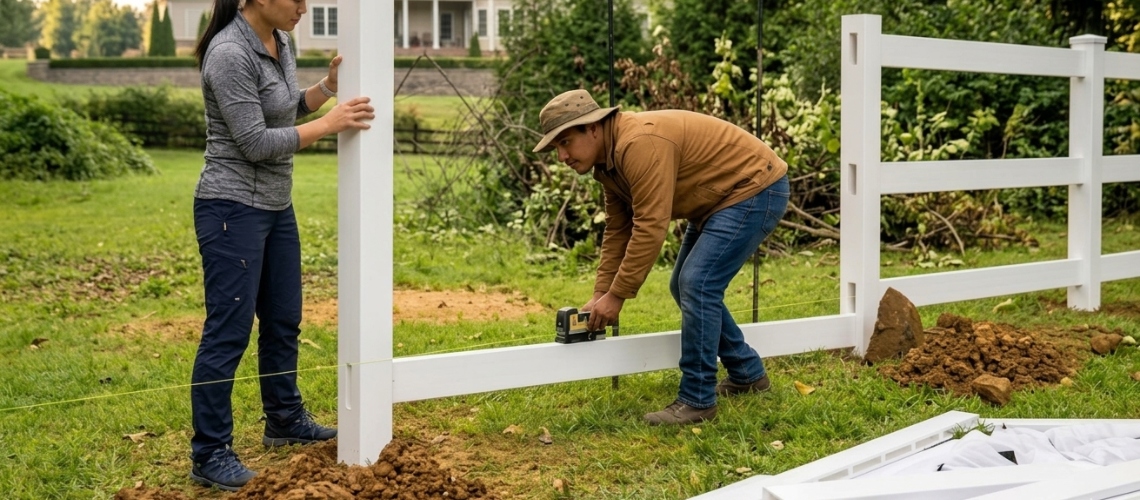
Certain site conditions and fence types shift the project firmly toward professional installation. These are the situations where DIY savings tend to disappear into corrections, failed inspections, or early replacement.
Sloped Yards
Grade changes require racked or stepped installation methods, and the choice between them affects panel selection and post spacing. Slopes also complicate gap control at the bottom of the fence, which matters for pets and code compliance.
Pool Enclosures
Pool barriers must meet specific requirements for height, gate hardware, latch placement, and gap sizing, and municipal inspectors check those details. A self-installed pool fence that fails inspection has to be corrected before the pool can be legally used.
Gates of Any Complexity
Swing clearance, frame gauge, hinge load, and latch alignment are precision work. A sagging gate is the most common failure on otherwise decent fences.
Large Properties
Long runs magnify small errors. A half-degree of drift over several hundred feet produces a visibly crooked fence line.
Commercial Sites
Commercial perimeters typically call for heavier-gauge materials, security hardware, and specifications that residential suppliers do not stock by default. These projects also tend to carry compliance requirements a residential DIY approach cannot cover.
Rocky or Ledge-Heavy Soil
Rock and ledge are common across Litchfield County, and often the point where a rented auger meets its match. Professionals bring the equipment and the judgment for it.
Permit-Sensitive Projects
Many Connecticut towns require zoning or building permits for permanent fences. A full-service contractor typically manages that process, while a DIY builder handles it alone.
Comparing DIY vs. Professional Installation
Here is how the two paths compare in practical terms:
|
Factor |
DIY Materials + Self-Install |
Full-Service Fence Contractor |
|
Material selection risk |
On the homeowner |
On the contractor |
|
Utility marking responsibility |
The homeowner must contact 811 |
The contractor coordinates utility marking before excavation begins |
|
Permit handling |
Homeowner |
Usually included |
|
Post depth and frost planning |
Homeowner judgment |
Built into the installation |
|
Inspection corrections |
The homeowner redoes the work |
Contractor corrects |
|
Workmanship warranty |
None |
Typically included |
How to Decide: A Step-by-Step Planning Checklist

Work through these steps before buying anything or signing anything. The answers make either path cheaper and cleaner, whether you handle the work yourself or bring in professional fence builders.
Step 1: Define the Fence's Job
Boundary marking, pet containment, pool compliance, privacy, or security. The purpose shapes everything that follows, from material to height to layout.
Step 2: Walk the Line
Measure each section and note anything about the ground that could complicate the work. Flat and clear conditions favor a DIY fence installation, while anything less predictable favors a pro.
Step 3: Call Your Building Department
Confirm permit requirements, height limits, and setbacks for your specific town before settling on a design. Local rules vary, and it is easier to plan around them than to correct for them.
Step 4: Price the Full DIY Scope
Account for materials, delivery, tools, concrete, hardware, waste, and disposal of any old fencing. The panels alone are only part of the real cost.
Step 5: Get at Least One Professional Quote
A written quote from a fence installation service gives you a real comparison instead of a guess. Look for specifics on post depth, materials, and gate details before weighing it against your own numbers.
Step 6: Compare Risk, Not Just Dollars
Ask what happens under each option if something shifts, sags, or gets flagged down the road. Talking with fence builders near you is worth the time when the answer is not something you want to handle alone.
➤ YOU MIGHT ALSO LIKE: How Much Does a Privacy Fence Cost Per Foot? A Full Pricing Guide
Signs Your Fence Project Has Outgrown DIY
Some projects reveal themselves as professional work only after planning starts. Watch for these triggers.
- The utility markings land directly on your planned fence line, and you are unsure how to adjust.
- Your town requires a permit, and the application asks for construction details you cannot confidently provide.
- The fence will serve as a pool barrier, and an inspection is part of the process.
- You hit a rock or ledge in the first test hole.
- The project includes a driveway gate, an automatic operator, or any powered hardware.
Frequently Asked Questions
Will a fence contractor install materials I bought myself?
Some contractors accept labor-only work, but many decline it because they cannot stand behind materials they did not select. Owner-supplied materials also shift responsibility for wrong specs and shortages back to the homeowner. If a contractor agrees, expect the warranty to cover workmanship only.
Can I do part of the fence project myself and hire out the rest?
Yes, splitting the work is common on budget-conscious projects. Homeowners often handle old fence removal, brush clearing, or staining while leaving layout, post setting, and gates to a professional. Post setting is the part least worth doing yourself, since most fence failures trace back to it.
What is included in a full-service fence installation?
A full-service contractor typically handles the site assessment, material selection, utility coordination, permits, excavation, installation, gate hardware, and cleanup. Many also offer old fence removal as an add-on. The scope varies between companies, so confirm what the quote covers in writing.
How much money does DIY fence installation actually save?
Savings come almost entirely from labor, which often makes up a large share of a professional quote. The real number depends on how much the homeowner spends on tools, delivery, wasted material, and corrections. Small, simple projects keep most of the savings, while complex ones tend to give it back.
What skills do I need to install a fence myself?
At minimum, you need to measure and lay out a straight line, dig consistent post holes, mix and set concrete, and keep posts plumb while they cure. Gate hanging requires more precision than most first-timers expect. If any of those steps feel unfamiliar, the project favors a professional.
Get a Clear Quote From a Fence Builder
A DIY fence budget can help you start planning, but a professional fence builder can give you a clearer view of the actual scope. Connecticut Fence & Gate helps homeowners and businesses plan fence, gate, deck, and railing projects with site-specific guidance from assessment through final review.
Our team considers layout, materials, gate details, permit needs, and local conditions so you can plan with more confidence before committing.
Call us or request an estimate online to compare your budget with a professional quote.