

What's In This Guide
- Can a Cracked or Damaged Vinyl Fence Be Repaired?
- Why the Repair-or-Replace Decision Affects More Than Curb Appeal
- Common Types of Vinyl Fence Damage and What Each One Means
- How to Assess Vinyl Fence Damage Before Calling a Contractor
- What Factors Influence Vinyl Fence Repair Estimates
- When a Vinyl Fence Repair Should Go to a Professional
- Frequently Asked Questions
- Ready to Repair or Replace Your Vinyl Fence?
A cracked picket after a windstorm. A puncture where a branch came down last week. A rail that flexes every time you lean on it. Each one looks like the same problem at first glance, but they are not.
Vinyl fence repair covers a wide range of situations, from a quick patch to a full section swap, and figuring out which one applies to your fence determines both the outcome and the cost.
This guide breaks down how to tell surface damage that can be repaired from structural damage that calls for new components, so you are not guessing before the next contractor visit or DIY attempt.
Quick Facts
- Small punctures and hairline cracks often qualify for surface-level patch repair.
- Cracked or bowed load-bearing rails typically require full component replacement.
- Vinyl fence components are commonly manufactured to the ASTM F964 material standard.
- Cold snaps increase brittleness, raising crack risk during winter impacts.
- Multiple damaged panels or leaning posts usually signal replace-over-repair territory.
Can a Cracked or Damaged Vinyl Fence Be Repaired?

Yes, depending on where the damage is. Small cracks, holes, or damage limited to one picket may be repairable without replacing a large section of the fence. Manufacturer installation guides show that many vinyl fence systems are assembled from separate rails, pickets, and posts, so individual parts can sometimes be replaced.
Damage involving a rail, post, or connection point usually needs a closer look because those parts play a larger role in how the fence is assembled and supported.
Vinyl fencing is typically made from rigid PVC profiles. The current ASTM F964 standard covers factors such as dimensional tolerances, extrusion quality, weatherability, impact resistance, warping, and dimensional stability for PVC fence and railing profiles.
The main question is whether a repair will restore the fence properly. If the damage is widespread or affects key components, replacing the damaged part may be the more practical option.
Why the Repair-or-Replace Decision Affects More Than Curb Appeal
It Protects the Fence's Structural Integrity
A vinyl fence relies on its rails and posts to hold the whole system together. Patching a picket that hides a cracked rail behind it does not fix the actual weak point, and that section can fail again under the next load, whether that is wind, snow, or a leaning dog.
It Prevents a Small Problem from Spreading
A loose bracket or a slightly displaced panel rarely stays that way. Left alone, the connection point continues to work loose, and what started as a one-panel fix can turn into a multi-panel replacement by the following season.
It Protects the Value of the Investment
A fence with mismatched patches, visibly different vinyl coloring, or an uneven panel line affects how the property reads from the street. Addressing the right sections correctly the first time keeps the fence looking intentional instead of pieced together.
Common Types of Vinyl Fence Damage and What Each One Means

Not all damage points to the same fix. Here is how to read the most common issues homeowners run into.
Small Holes and Punctures
A vinyl fence hole repair is usually the most straightforward fix on this list. Small punctures from a ball, a tool, or a minor impact typically stay contained to a single picket or rail face and do not affect the fence's structural function.
Cracks and Split Pickets
A hairline crack that has not spread is often a candidate for a patch or single-picket swap. A crack that runs the full length of a rail or splits the picket at a connection point usually means the component needs to be replaced rather than repaired.
Broken or Sagging Rails
Rails carry the structural load between posts. A rail that has snapped, bowed, or pulled loose from its post connection is a repair-cracked-vinyl-fence scenario where a surface patch will not hold, since the piece is no longer doing its job structurally.
Displaced or Dislodged Panels
Panels that have popped out of their post channel, often after a storm or a heavy impact, may simply need to be reset and resecured. If the channel itself is cracked or the panel edge is damaged, replacement is the more reliable option.
Loose Brackets and Connectors
Hardware connecting rails to posts can loosen over time from temperature swings and repeated wind pressure. This is frequently a straightforward hardware repair, not a full-component issue, as long as the surrounding vinyl is intact.
Shifting or Leaning Posts
A leaning post is rarely a vinyl problem. It usually points to ground movement, a compromised footing, or a post that was not set to an adequate depth for local conditions. This category of damage should be evaluated on-site rather than diagnosed from the fence line alone.
Warped or Discolored Sections
Warping typically shows up on sections exposed to prolonged direct heat or on lower-quality vinyl that has aged past its intended lifespan. A warped section rarely returns to its original shape, which puts it in replacement territory even without visible cracking.
How to Assess Vinyl Fence Damage Before Calling a Contractor
Walking the fence line with a clear process helps you describe the damage accurately when you do reach out for an estimate.
Step 1: Inspect the Damage Up Close
Look at each affected section within arm's reach. Note whether the damage is surface-level, such as a scuff or shallow crack, or whether it goes through the material.
Step 2: Test for Movement and Flex
Gently press on the damaged rail or picket. Excessive flex, a hollow sound where there should not be one, or visible give at a joint suggests the component has lost structural integrity.
Step 3: Check How Many Components Are Affected
Count the number of pickets, rails, and panels involved. Isolated damage on one section leans toward repair. Damage spread across several panels, or repeated damage along one run of fence, leans toward replacement.
Step 4: Look at the Posts and Gate Connections
Posts and gate hardware carry the most structural and functional weight in the system. Any lean, crack, or looseness at these points warrants a closer look before deciding on repair versus replacement.
Step 5: Match the Decision to the Damage
Use what you have found to sort the issue into one of two categories: cosmetic and localized, which usually supports a patch or component swap, or structural and connected to load-bearing parts, which usually supports replacement.
READ MORE: How to Pick the Best Fence Vinyl Style for Your Home in Connecticut
What Factors Influence Vinyl Fence Repair Estimates
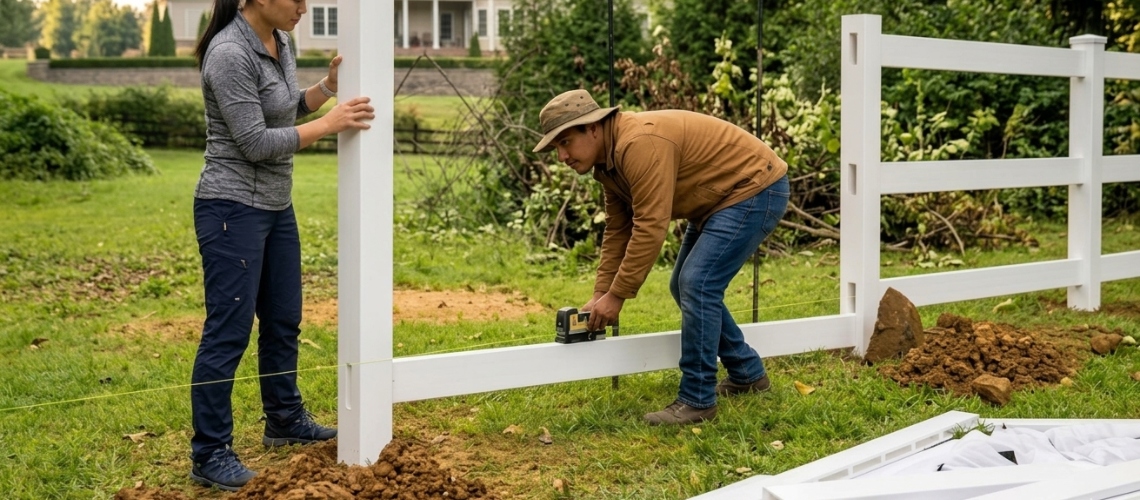
Vinyl fence repair costs vary widely and depend on the specific scope of the damage, not a flat per-panel rate. A realistic estimate accounts for several site-specific and material-specific factors rather than a single number that applies to every property.
Homeowners requesting an estimate should expect the following to factor into the final scope:
- Extent and type of damage: A single scuffed picket costs less to address than a cracked rail or a compromised post.
- Number of affected components: Isolated damage is simpler to price than damage spread across multiple panels.
- Color and style matching: Older vinyl fences may have discontinued colors or profiles, which can affect material sourcing.
- Access to the damaged section: A fence running near landscaping, slopes, or tight property lines can add labor time.
- Whether posts or gates are involved: Post resetting and gate hardware work typically carry more labor than panel-only repairs.
Because these variables shift from property to property, an accurate number depends on a site visit rather than a phone estimate.
When a Vinyl Fence Repair Should Go to a Professional
Repairs involving posts, gates, load-bearing rails, or multiple panels are best evaluated by a qualified fence professional before any work begins. These components affect the fence's overall stability, and a repair that does not address the underlying cause tends to fail again.
A professional assessment is particularly worth scheduling when:
- The fence functions as a pool barrier or another safety-related enclosure, where gate hardware and panel integrity should be evaluated by a qualified professional rather than assumed sound.
- A leaning post suggests a footing or ground-movement issue rather than surface damage alone.
- Damage appears across three or more panels, which often points to a broader installation or material issue.
- Color or profile matching is uncertain, and mismatched replacement panels would be more noticeable than the original damage.
DIY patch kits can handle small, cosmetic fixes. Anything touching the fence's structural components is worth a second set of eyes before it goes back together.
Frequently Asked Questions
How long does a typical vinyl fence repair take in Connecticut?
Timing depends on the damaged area, access, and whether replacement parts are readily available. Many smaller vinyl fence repairs can be completed in a single visit, while larger jobs may take longer.
Can I pressure wash a vinyl fence after it has been repaired?
Usually, yes, once the repaired area is secure. Use a moderate setting and avoid holding the spray too close to patched areas, joints, or hardware.
Should I keep spare vinyl fence parts after installation?
Yes, if you have the space. Extra pickets, caps, or hardware from the original fence can make future vinyl fence repair easier, especially if a style or color later becomes harder to match.
Will a vinyl fence repair affect the manufacturer's warranty?
It depends on the product and the type of repair. Warranty terms vary, so homeowners should check the original paperwork or manufacturer guidance before making major modifications.
Can vinyl fence repairs be done year-round in Connecticut?
In many cases, yes. Weather and ground conditions can affect scheduling, especially for work involving posts or footings. Smaller surface repairs may be less dependent on the season.
Ready to Repair or Replace Your Vinyl Fence?
Connecticut Fence & Gate has installed and repaired fencing for homeowners across Litchfield County, Fairfield County, and lower Westchester County, NY, for more than 20 years. Every repair call starts with an honest look at what the fence actually needs, not an assumption that replacement is the only option.
If a section of your vinyl fence needs a closer look, request a free estimate and get a straight answer on what it will take to fix it right.