
What's In This Guide
- What Shapes Split Rail Fence Cost on Your Property?
- Split Rail Fence Styles: Which Rail Count and Wood Fit Your Yard?
- Split Rail Fence With Wire: When Mesh Is Worth Adding
- What Keeps a Split Rail Fence Straight Through Connecticut Winters?
- Planning Checklist: 6 Steps Before You Request Quotes
- Frequently Asked Questions
- Ready to Plan a Split Rail Fence That Lasts?
Split rail fence cost is often lower than the cost of solid privacy fencing because the design uses fewer boards and less hardware per linear foot. However, the final number still depends on the wood, the rail count, the ground under the posts, and whether you add wire mesh.
Quick Facts
- Split rail fence cost depends on wood species, rail count, terrain, and finish.
- Wire mesh adds pet containment but changes both materials and labor.
- Post depth and drainage affect lifespan as much as rail style does.
- Rot-resistant woods cost more upfront but may last longer in wet ground.
- A site visit gives the most reliable estimate for your specific property.
What Shapes Split Rail Fence Cost on Your Property?

A typical split rail fence installation costs $2,250 to $5,500 for materials and labor, and your total fence length drives that price: split rail fence cost varies with the overall scope of the job rather than a flat rate. A basic two-rail pine layout on open, level ground may sit at the lower end of the estimated range. A three-rail cedar or black locust run with gates, wire mesh, and ledge rock to work around can land well toward the higher end.
These factors move the number most:
- Length and layout: More linear feet and extra corners mean more posts and additional labor.
- Wood species: Pressure-treated pine, cedar, and black locust sit at different price points and lifespans.
- Rail count and height: A third rail adds material and setting time.
- Terrain and soil: Slopes, ledges, and tree roots slow digging and may call for extra equipment.
- Gates and wire mesh: Both add hardware, materials, and installation time.
- Removal and access: Tearing out an old fence or hauling materials to a tight lot adds labor.
- Permits and timing: Local requirements and seasonal scheduling can shift the total.
Pricing usually treats wire mesh, gates, removal, and grading as add-ons on top of the base fence, which matches what we see on real estimates. Material choice shifts the estimate the same way, as shown by how aluminum and vinyl fence costs differ.
The order of work matters, too. Grading or patio construction completed after fence posts are installed may require posts to be repositioned, so coordinating fence installation with grading and landscaping work should be part of the initial budget discussion.
|
Setup |
Relative Estimate |
What Moves It |
|
Two-rail pressure-treated pine, level ground |
Lower |
Length, post count |
|
Three-rail cedar |
Moderate |
Wood cost, added rail |
|
Black locust posts and rails |
Typically higher |
Material availability, durability |
|
Any style with wire mesh |
Adds to the base estimate |
Mesh height, burial, labor |
|
Rocky or sloped site |
Adds labor and equipment |
Ledge, grade, access |
Every yard differs, so a site visit provides a more reliable estimate based on your property's specific conditions. Treat any online range as a starting point, not a quote.
Split Rail Fence Styles: Which Rail Count and Wood Fit Your Yard?
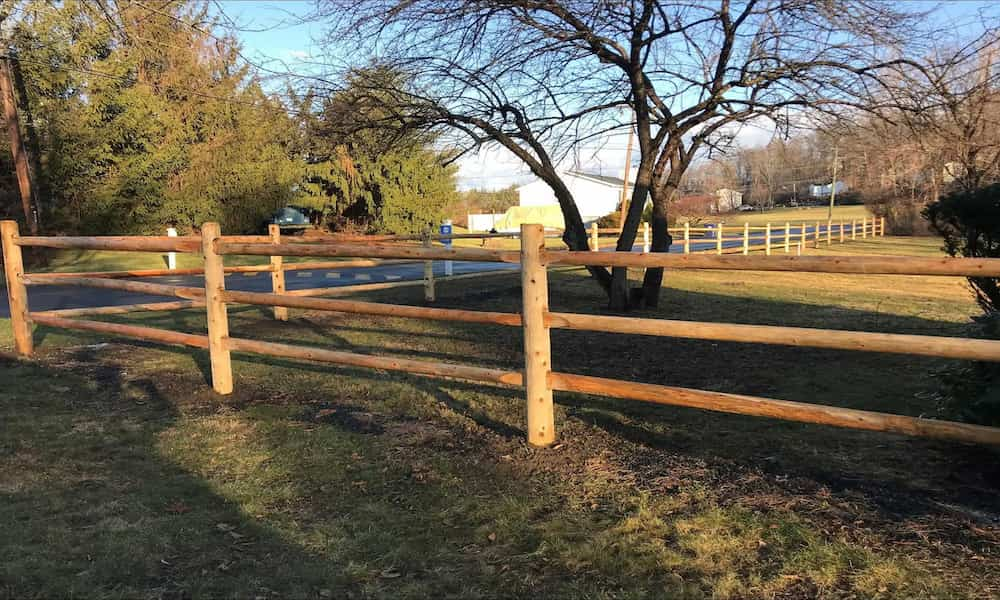
Two-rail pine suits a simple boundary, three-rail cedar suits visible frontage, and black locust suits ground that stays wet. The right pick depends on what the fence has to do.
Two-Rail Split Rail Fence
This is the traditional low-profile style. It marks a line without blocking sightlines and uses the least material. On its own, it will not contain pets.
Three-Rail Split Rail Fence
A third rail adds presence and a clearer boundary. It also gives wire mesh more to anchor to, which is why it is the common starting point for pet enclosures.
Four-Rail Split Rail Fence and Taller Layouts
Taller layouts are usually reserved for larger animals and acreage. If you want a cleaner, milled look at that height, post and rail often fits better than hand-split rails.
Pine, Cedar, and Black Locust
Pressure-treated pine is the budget-friendly choice. Cedar naturally resists rot and insects and weathers to an attractive silver-gray. Black locust is a dense Northeast hardwood known for holding up well in ground contact. Homeowners leaning toward solid panels can weigh how vinyl and wood fence panels compare in Connecticut.
Moisture drives decay, and USDA Forest Products Laboratory research notes that serious decay occurs above the fiber saturation point of wood. In wet Connecticut soil, species choice and drainage both matter. Wood also moves with the seasons. Rails seated in post mortises need room to swell and shrink.
Split Rail Fence With Wire: When Mesh Is Worth Adding

A split rail fence with wire turns an open boundary into a containment line for dogs and small animals. The tradeoff is added materials and labor.
What Wire Mesh Actually Solves
The gaps between rails are wide enough for pets and small animals to slip through, but mesh closes them. Match the mesh opening to your smallest animal, match the height to your best jumper, and bury or bend the bottom edge outward to deter diggers.
Mesh does not turn a split rail fence into a deer barrier. Deer clear fences far taller than most split rail layouts.
Where Rough-Hewn Rails Complicate Wire
Traditional split rails are hand-split and irregular, so mesh attaches mostly to the posts and sits unevenly against the rails. For dogs that push against a fence, a post-and-rail design with welded wire backing provides a more secure attachment while maintaining the rustic look from the street.
Galvanized welded wire can offer greater rigidity than lighter woven wire, although durability depends on wire gauge, coating, and installation quality. When full containment is the priority, the cost of chain link fence is worth weighing against mesh on rails.
Keeping Mesh Clean and Well-Maintained
Mesh catches leaves and debris along the base. That debris holds moisture against the bottom rail, and water that stands along a fence line usually points to a grading or runoff problem, not a lumber problem. A quick clear-out each season protects the wood and the wire.
What Keeps a Split Rail Fence Straight Through Connecticut Winters?
Proper post depth, secure installation, and drainage help keep a fence straight and stable. Freeze-thaw cycles can lift shallow posts, and posts set in poorly drained ground may loosen over time.
On rocky Litchfield County lots, crews often hit ledge or large stone before reaching full depth. That takes extra time and sometimes different equipment, which is why a low quote that skips ground conditions deserves a second look. Gates take the harshest winter wear, and knowing how to maintain an automatic gate in winter helps keep openers and hinges working.
Planning Checklist: 6 Steps Before You Request Quotes

- Define the job. Decide whether the fence is a boundary marker, a pet enclosure, or a barrier for larger animals.
- Confirm the boundary. Verify your property line, and check HOA and town rules, since permit and setback requirements vary.
- Mark gate locations. Set widths and swing direction before posts go in. Gate posts carry extra load and need stronger support.
- Prepare the site. Identify sprinkler lines, landscaping features, and underground utilities to reduce the risk of damage during digging.
- Plan the utility call. Connecticut requires excavators using power equipment to notify Connecticut's Call Before You Dig program at 811 at least two full working days before digging. A hired contractor handles that notice.
- Choose wood and wire together. Mesh height, rail count, and post spacing should be decided at the same time.
Frequently Asked Questions
Can I install a split rail fence myself to lower the cost?
DIY installation may reduce labor costs, particularly for short fence runs on level ground. However, rocky soil, uneven terrain, and gate installation can make the project more challenging. You will also need appropriate tools and accurate property measurements. Comparing material costs, equipment rental, and professional installation estimates can help you decide whether DIY is worthwhile.
Does a split rail fence need staining or sealing?
Staining or sealing is not always necessary, especially for naturally durable woods such as cedar and black locust. However, applying a compatible protective finish may help maintain the wood's appearance and reduce moisture absorption. Maintenance needs depend on the wood species, exposure, and finish. Follow the manufacturer's recommendations before applying any treatment.
How long does a split rail fence typically last?
A split rail fence may last 15 to 30 years or longer, depending on the wood species, installation quality, soil conditions, and maintenance. Naturally durable woods and properly treated lumber may offer longer service lives under suitable conditions. Regular inspections can help identify deteriorating posts, loose rails, and other issues before they require extensive repairs.
Can you replace individual split rails without replacing the entire fence?
In many cases, damaged or deteriorating rails can be replaced without removing the entire fence. Replacement depends on the condition of the posts, the rail dimensions, and whether compatible materials are available. If multiple posts have deteriorated or shifted, a more extensive repair may be necessary. A professional inspection can help determine the most practical option.
How close can a split rail fence be installed to a property line?
The allowable distance depends on local zoning regulations, property restrictions, and any applicable HOA requirements. Some Connecticut municipalities may have specific rules regarding fence placement, height, and visibility near roads or intersections. Before installation, verify your property boundaries and check with your local building or zoning department to determine which requirements apply.
Ready to Plan a Split Rail Fence That Lasts?
Split rail fence cost depends on your property's conditions, your fencing goals, and proper post installation. Connecticut Fence & Gate builds rustic boundaries, pet enclosures, and custom layouts across Litchfield County, Fairfield County, and lower Westchester County, NY. Each fence installation for Connecticut and Westchester properties is planned around the property's specific conditions and requirements. Pool enclosures follow separate safety requirements, so code-compliant pool fence costs in Connecticut are estimated on their own.
Request a site visit and you will get an estimate based on your actual yard.